Site institutionnel Institutional website
Province de France Province of Europe
PROVINCE OF EUROPE Découvrir la Province Europe Autriche Marchegg Belgique Banneux Italie Rome Lituanie Vilnus Pays-Bas La Haye Utrecht Angleterre Londres Roumanie Bucarest Suisse Genève
PROVINCE AFRIQUE Découvrir la Province Afrique Côte d’Ivoire Abidjan Cameroun Simbock Yaoundé Éthiopie Addis-Abeba Guinée Coyah Sénégal Poponguine Togo Kara Lomé

The inauguration of our church

Published on 27 March 2021

Inauguration of Saint John the Evangelist’s church

On this grand opening day of Saint John Church, several hundred guests gathered in a festive and joyful atmosphere. Starting at 9 a.m. many people from the French-speaking parish, from the Catholic Church of Ethiopia, from the neighbourhood, some of the community member’s families and some workers involved in the construction, came and met on the freshly flowered church forecourt.

The prior general of the Saint John Community, father François Xavier Cazali, came in Ethiopia for this occasion which represents a major step for the Entoto priory.

Abune Lesane Christos, bishop of Dare Dessie and the priests turned around the building three times, preceded by the Ethiopian youth choir and followed by the crowd, while the bell rang regularly (watch the Youtube Video).

After the ceremony of handing over the keys of the big wooden doors, the faithful discovered the interior of the church, decorated with many ornaments for this occasion The night before, most of the furniture had been blessed during a prayer vigil in which a relic of Saint John Paul II was exposed It is now in the altar stone

During the inaugural mass, the crowd sang beautiful songs in Amharic, in English, in French or in West African languages. The multiplicity of languages used to praise the Lord testifies to the multiculturalism of our Christian community in Addis Ababa. During all the inauguration’s preparation, young Ethiopians who came in the past to our School of Life events helped us, and some of them were also involved in the choir. Their fidelity to the community is a way to thank for the organised activities, the summer camps, the weekends and every moment they spent with the Brothers of Saint John during the ten past years

After the blessing of the walls, of the stained glass, and of the altar, cardinal Berahneyesus celebrated the first mass in this new chapel

After the mass, Abba Philip offered some presents to the Cardinal, to the prior general, to workers and to main actors of the project. Then the crowd went to the basement to bless the lunch. Families prepared several buffets: an Ethiopian buffet with the famous injera and ginger drinks, a West African buffet with traditional African food, and an other which was dedicated to European food.

This magnificent day and those enjoyable moments shared with the Catholic community of Ethiopia honoured the long term work that we begun years ago. The objective of welcoming in good conditions the youth, the elder, Ethiopians, foreigners, orphans and expatriate to the Saint John’s priory of Entoto is now closer than ever.

However, there is still some work to do final adjustments in the chapel, backfilling and site work, paving, water and energy networks, work in the basement, construction of the guardian’s house, etc.

We hope you will come soon to pray here in our chapel of Entoto priory

We thank again all those who helped us during the year, especially for the project funding and the inauguration’s preparation !

How a stained glass window was done at home

Published on 3 February 2021

Christ's stained glass window welded at the priory

For the second time, our master glassmaker, Paul Challan Belval, came to visit us. During 3 weeks he was at work…

The dream come true

This time, the drawings had become reality! The stained glass window of the Virgin and Child and the Angel Gabriel arrived all assembled, well packed in wooden cases. But the most spectacular thing was to see the assembly of the stained glass window of Christ before our eyes. The conference room with view on the church, which will receive this stained glass window, was transformed for a few days into a workshop. It is there that we began the steps of assembling a large circular stained glass window which will be placed behind and above the altar of our church.

The stained glass window of Christ

The stained glass arrived in pieces, well packed and protected, they also arrived in a wooden case. There were still many steps to form the final result:
Each piece being already cut out, it was now necessary to put them all together like a giant puzzle so that each one could take its place in the work. Small annotations were there to help: 1, 2, 3…, right arm, left arm, dextera, senestra (in Latin please), etc.

Soldering preparation

The second step was to crimp each piece with a copper strip to prepare for welding. This was patiently done by our volunteers. Then, to prepare for the tin to adhere, a layer of stripping oil had to be applied to the copper strips. Finally, the tin soldering will take place. It must be done on both sides of the stained glass. The glassmaker, patiently, soldered each piece, one after another with each other and Jesus let it be done to him (15 hours of soldering).

Now the stained glass is waiting for the chapel to be ready to receive it.
Paul Challan Belval must be back shortly before the inauguration to preside over the installation. (He is the one who knows the strengths and weaknesses of his stained glass to place it without breaking it).

Technically

The beauty of our stained-glass windows is due, among other things, to the quality of the antique glasses that have been chosen: mouth-blown in the traditional way, they are tinted by the salts and various crystals introduced into the molten glass.

Concretely, this also means that each piece had to be ground to rectify the edges. Indeed, the antique glasses will have very varied thicknesses ranging from 2 to 7mm, they will be cut according to each pattern and then, the incised glass will be opened by hand, so there are shards, facets and overflowing cuts …

As for the mounting, you probably knew that stained glass windows are traditionally fixed with lead. But the technique chosen for the assembly of each of the stained glass windows in our chapel will be copper crimping. In this technique invented by Louis Comfort Tiffany at the dawn of the 20th century, thin strips of copper (a quarter of a millimeter) are stuck on the perimeter of each glass. Thus each glass crimped will find its neighbor, and the tin soldering bringing together the copper will unite the pieces.

Finally, another technique that allows the beauty to shine through in the details of the stained glass is the glass paint that is applied before firing. It is composed of metallic oxides, which will be incrusted into the glass during firing and will bring out the face, hands and other details of the body of Christ.

Numbers

Not to mention all the hours of research, drawing and glass cutting…
The assembly of this stained glass in Addis, represents :

  • 7 hours of unpacking and arrangement of the pieces
  • 200 pieces of glass (from the largest to the smallest)
  • a diameter of 1.40 meters
  • 6 hours of grinding
  • 24 hours of tin crimping (counting Foucauld and Jean-Désiré’s hours)
  • 15 hours of welding (including 3 hours of brass strapping)
  • and 1 hour of cleaning with sawdust.

Meaning

The words written in Amharic around the cross are Jesus’ words to Mary and John from the top of the Cross: “Behold your Son”, “Behold your mother” (Jn 19:26-27).
The presence of the Holy Spirit in Jesus’ offering to his Father is expressed by the presence of the Dove above the Cross. “He gave up his Spirit” (Jn 19:26-27).Finally, the decorative motifs surrounding the cross itself are inspired by Ethiopian religious art.

If you want to help:

Just printed: the Gospel for children

Published on 27 January 2021

excerpt from the book - wengel letsanat

A new book to introduce the gospel to children.

It has just been released in the “Children of Hope” collection and it is available for children. families to transmit the gospel to the youngest.

More than twenty episodes of the Gospel told and illustrated, to help children to discover the life of Jesus: the Annunciation to Mary, the birth of Jesus, life in Nazareth, the discover of Jesus in the Temple, the baptism of Jesus , the call of the Apostles, the wedding feast at Cana, the calm tempest, the multiplication of the loaves, the Our Father, the discourse on Providence, the parable of the lost sheep, Jesus and the children, the blind man in Jericho, the conversion of Zacchaeus, entry into Jerusalem, arrest of Jesus, Resurrection, Ascension.

With very beautiful images and simple text, it will be a great excellent tool for parents to share with their younger children and make them know, discuss and meditate on the life and teachings of our Lord.

Do not hesitate to order it or come visit us to pick it up.

The first stained glass window of the chapel

Published on 18 November 2020

Vrigin Mary stained glass window

Realization of the stained glass

The first stained glass window of the chapel is finished! It was the fruit of a long work. During a 15-day stay in Ethiopia with the Brothers of Saint John, Paul Challan Belval observed the country, the tradition, the iconography, the people, and he began the drawing of ethiopian version of the Madonna with Child. Back in Chartres, he proceeded to the realization of the stained glass in his own workshops.

Reflection on colors

At first glance, we might be surprised by the colors when we look at them with western eyes.

These reactions on colors bear the mark of two different cultures: in the orthodox culture, at least slavonic, the Virgin is in red to signify blood, the incarnation (thus Vladimir’s Virgin who appears black to us was initially red before the painting became black).

Blue, is in this iconographic culture, reserved for the divinity. But in Western culture blue has become the attribute of Mary, so much so that it is called the Marian color. It is in fact with the XII° century that blue becomes such in the West. The King of France chose it in the XIII°. In the stained glass windows, it is because cobalt blue was the most expensive color that it was chosen to honor Mary: the example of Notre Dame de la belle verrière in Chartres is a remarkable example.

For our stained glass window, the innovation lies in the green mantle. But it’s because the blue having been chosen as the background for all our stained glass windows, it would have been a loss to give it back for the mantle. Symbolically, green recalls the peace and life that springs up, culturally, the colors of Ethiopia, and naturally, green joins red, gold and brown to evoke the rich foliage of autumn, all on a background of source blue. If Creation uses these same colors in its harmony, then we are not mistaken in imitating it.

Paul Challan Belleval

News from the construction site

Published on 23 September 2020

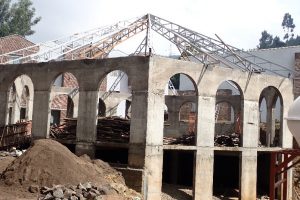
Once the chapel walls being risen up, the realization of the roof could start. A steel and wooden framework was welded and installed, before laying on tiles. Installing the cross on the ridgepiece of the building was an important and delicate moment. The purpose of the building can now be seen by everyone and it is a supplementary motivation !

Deliberations are making good progress for the design of the gates and the stained-glass windows. A stained-glass artist went from France for few weeks in order to design windows in harmony with the local culture and to study which manufacturing methods could be used there.

A retaining wall was poured simultaneously in partnership with the neighbour : the wall demarcates his parcel and the Community’s one.

families meeting

Four camps followed each other from late August to early September. In the priory took place a first camp with students from all over the country, a second one with around twelve children from the orphanage of Kidane Meheret et a third one dedicated to family, for three couples accompanied by their children. One last students camp was organized in Hawassa on the theme of peace.

Those camps need a lot of preparation and an active involvement of each one of the Brothers. Teachings, treasure hunts, artistic and manual activities… followed on each other for several weeks to revive the Centre after the long break due to the Covid crisis.

Summer Camps 2020

Published on 17 September 2020

Brother at Hawassa camp

This year, we have organized 5 summer training camps for around 280 youth people from all the dioceses of Ethiopia especially Addis-Ababa and Awassa for two months.

Although the pandemic asked us to revise our projects, we decided to organize and adapt them to meet the wish and desire of many Youth to participate to these different programs.

Due to Covid-19 pandemic, this desire was more special this year: the schools were closed for the last 6 months, and those Youth have a real lack of activities. With strict rules of social distancing, we decided to stick with a camp program, but we restricted the number of people attending to them.

You can find among them teenagers, students, young workers from their Parish, but also families from Ethiopia and even Mexico. The objective of all these summer camps remains the same: to give Christian formation to young people and to help them to feed their spiritual life.

1/ Teenagers’ camp 1 (16th-19th July): Entoto

During 4 days in Entoto, we organized one Teenager’s Camps with 20 teenagers from Addis Abeba. Br Philippe-François, Br Lazare, Br Ermias, with help of 2 French and 3 Ethiopian volunteers, framed them.

This young people could receive formations with brothers, activities, workshops, games, sport, and prayer. The main topic of the camps was how to use faith.


2/ Teenagers’ camp 2 (23 th-26 th July): Entoto

During 4 days in Entoto, we organized one Teenager’s Camps with 20 teenagers from all the country including Awassa’s Youth. Br Benoit David, Br Ermias, one postulant, with help of 2 French and 4 Ethiopian volunteers, framed them.

This young people could receive formations with brothers, activities, workshops, games, sport, and prayer. The main topic of the camp was prayer.


3/ Children’s camp (21th-24th August): Entoto

Continuing our experience of last year, with 16 orphans from Kidane Mihret in Addis-Ababa, we went to the priory, accompanied by Br Athanase, Br Ermias, 2 French and 4 Ethiopian volunteers and one postulant.

For 6 days, there were brothers’ teaching and formations, activities, workshops, games, and sport. The topic of the camp was the Virgin Mary.


4/ Formation camp (27th August- 1st September): Awassa

Like the last year, we organized in Awassa a Formation Camp for students and young workers. They were 20 young who came from all the country including Awassa Youth.

We spoke about Peace in the world.

For 6 days, Br Benoît David, Br Lazare From the Mother of God, Br Yohanis, Br Paul-Clément and four volunteers Gauthier and Constance (from France) and Cisaï and Tadesse (from Ethiopia), framed them.


5/ Family camp (3rd-7th September): Entoto

For the first time, this year, we organized a Family Camp. Gathering 2 Ethiopian (one couple and one couple and 3 children) and one Mexican (one couple and 6 children) families.

We had two separate programs, one for couples and one for children, along with activities and meals in family. The goal was for the families to have a resourceful time together and  for the couples to also have couple time

For 5 days, Br Benoît David, Br Yakob, one postulant and 6 volunteers Gauthier and Constance (from France) and the others from Ethiopia, framed them.

The testimony of Gauthier and Constance (volunteers)

Published on 10 September 2020

“We have very complementary roles in the life of the priory.”

Aged 27 and 25, Gauthier and Constance decided to dedicate their first year of marriage to a mission for Eastern Christians. Their testimony in the midst of a complicated journey is strong.

We are Gauthier and Constance, we got married in September 2019, and decided to go on a mission for our first year of marriage. We were to leave with the Oeuvre d’Orient for the Holy Land in March 2020. Due to the Coronavirus pandemic, the borders of Israel closed at the time of departure and thus forced us to change our plans. The Oeuvre d’Orient finally redirected us to another mission, in Addis Ababa, Ethiopia, with the Brothers of Saint John, while waiting for the reopening of the Israeli borders.

From a mission that was supposed to last only a few weeks, here we are again in Addis after 6 months! Since March, our missions have been very varied, from French and English courses, translations of archives, setting up fundraising projects for communities, organisation and animation of camps for young people, and we are now in charge of the construction site of the Brothers’ chapel.

The departure:

We had discerned this desire to go on a mission since our engagement. We had wanted to save the Christians in Iraq with all our heart. However, we quickly decided that it was better to put ourselves at the service of Eastern Christians in general for the Work and to trust them in the choice of mission.

Once we were certain that we were going to leave, the difficult and liberating act that changed everything was for both of us to announce our departure and resign. So, to explain to our families, friends and colleagues why we were leaving. The mission had already begun!

The Brothers of Saint John in Ethiopia:

The Brothers of Saint John have been living in Ethiopia for 10 years. They have three main missions in Addis Ababa: youth ministry animation in Ethiopia, animation of the French-speaking community of Addis Ababa, and the formation of brothers.

We are installed in the new brothers’ centre on Entoto Mountain. The buildings, to which more than a dozen volunteers of the Work have contributed over the last 4 years, are almost new, and big enough to welcome the brothers, young people, volunteers, families… It is a house that lives, there is always something going on. The last phase of the construction project of this centre is the Chapel so that everyone has a dedicated place to pray. We have been seeing it take shape for the last 6 months.

Because of or thanks to the Corona, we have arrived overnight in the life of the brothers and the priory. We were with two other volunteers of the Work. First of all we gave French and English lessons to the postulants, then, when the other two volunteers left, we took over the work on the chapel. Since the beginning of March, the activities at the Priory have been put on hold, and for the past few weeks they have resumed, with prudence and confidence, so as not to let this faith fall asleep in the hearts of the Ethiopians being supported.

Life in Community:

We discover and share the community life of 8 brothers, 2 postulants and 3 volunteers (including us). We are surprised by the youth of these brothers; they are our age. They are almost like roommates but with a prayer life.

We have been in Addis for 6 months, in a male community, where Constance is the only woman. The meals and the spaces are communal, our private space as a couple is therefore very small, we share our joys and our disputes with the brothers!  Each of us had to adapt ourselves to community life and the brothers to understand our needs as a couple.

To all this we add a lot of cultural differences, it took time and discussions to get to know each other, and to accept each other as we are. This is what makes the richness of the community. Thanks to the brothers, we have a very dynamic life in Addis, and we meet many communities, many young people, and this allows us to deepen our knowledge of Ethiopia in depth. Without them, our mission would not have been so rich in so little time.

After this period where everyone has had to find their place, living together is going really well. We have this chance to share our testimony of God’s love with each of our commitments: religious life or Marian life.

Mission and everyday life:
What a joy to be together at every moment of the day, to have lunch, to work, together. To be able to have real discussions at any time of the day, to not have to make a single phone call for 6 months. We have the chance to build our marriage based on our missionary life, of which there will be many in our future life in France.

It is a great richness to be able to serve the Church as a couple, we learn a lot about each other, have the chance to marvel and be amazed at everything together. The construction of a chapel is also a magnificent symbol when we start a life together, nothing is really built without the presence of God.

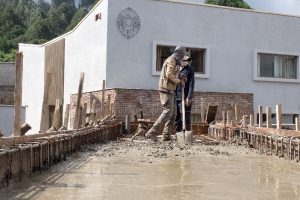
We had to find our own role in this mission and this place according to our own appetites and abilities. Gauthier takes care of the day-to-day running of the site, he anticipates and solves all the problems, he spends a lot of time in the field. Constance has more responsibilities in the life of the priory: organisation of the camps, daily life, workshops… She also helps the brothers with the aesthetic aspect of the chapel; the cross on the roof, the furniture and paintings, layout… We have very complementary roles in the life of the priory, which allows us to work together without constantly stepping on each other’s toes, and therefore work serenely with the brothers.

Being a missionary couple in Ethiopia:
We are always happy to meet Ethiopian families and to be able to share about married life with our so different cultures but sharing the same faith and the same sacraments.

We have chosen to live a slightly different fertility for this first year of marriage, but our situation here is always surprising. That we can devote this year to something other than having children is surprising, and they are quite right! It was also a difficult choice for us, but we are more than happy and fortunate to be able to live these rich moments of discovery and time together before devoting ourselves to our family.

We are in constant contact with many young Catholics from all walks of life in Addis: students, children, young professionals, teenagers… We are fully aware of our duty to witness to our sacrament of marriage. As everywhere in the world, the tendency is not towards commitment; therefore we have an important role to play: to show that through our faith and commitment we can transmit, on our own small scale, the joy and realities of family love, despite all cultural differences.

Finally:

Surrender and trust. Since we have given up everything (job, flat, family…) even if it is not pink every day, we receive graces by the thousands. In the beginning, we had to take on ourselves, go towards others, make our talents and desires known and develop them. Now, we are reaping a lot of the fruits of these efforts.

We do not know what the next 6 months will be like, but we trust in God’s plans for the end of our mission.

This article has been published in french on the website of the Oeuvre d’Orient at the following address:
https://oeuvre-orient.fr/actualites/ethiopie-le-temoignage-de-gauthier-et-constance-nous-avons-des-roles-tres-complementaires-dans-la-vie-du-prieure/